Inferring the Distribution of Fitness Effects (DFE) in Microbial Systems
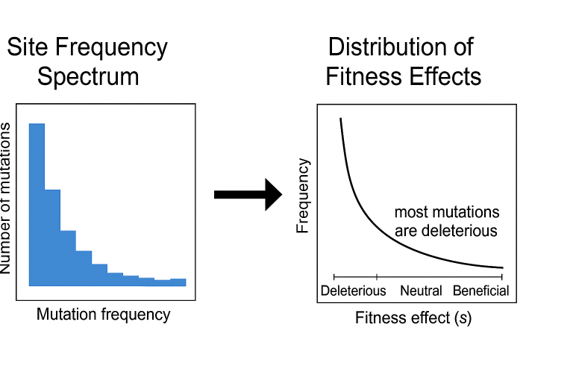
Building on genome-wide mutation datasets, I am exploring approaches to infer the distribution of fitness effects using site frequency spectrum frameworks. This involves adapting classical DFE inference methods to haploid microbial populations experiencing spatial heterogeneity and bottlenecks.
The goal is to better characterize beneficial and deleterious mutation landscapes in experimentally evolving microbes.
Techniques: Site frequency spectrum analysis, statistical modeling, likelihood-based inference, and mutation effect categorization.
Spatial Structure and Adaptive Divergence in Pseudomonas fluorescens
This project investigates how environmental heterogeneity shapes evolutionary trajectories in microbial populations. Using spatially structured agar environments with nutrient patchiness, I evolved Pseudomonas fluorescens populations over multiple generations and compared adaptation between center and edge subpopulations. Through whole-genome sequencing and mutation analysis, I quantified genetic divergence, assessed gene flow, and evaluated patterns of parallel evolution. This work explores how spatial structure influences local adaptation and evolutionary predictability.

Modeling Gene Flow and Evolutionary Dynamics in Structured Populations
To complement experimental findings, I am developing computational models to simulate migration, selection, and mutation across spatially structured microbial populations. Using Wright–Fisher and stochastic simulations, I am exploring how varying migration rates influence genetic similarity over generations. This project will help quantify how dispersal shapes adaptive divergence and genetic convergence.
Techniques: Population genetic modeling, stochastic simulations, migration models

